
Your text is already in Dutch. Below you will find a greatly expanded and much longer version of the article, with further explanation, background information and more content.
Ready for a fun brain teaser? At first glance, this visual puzzle seems surprisingly simple. You look at the image and might think it’s just a collection of shapes, lines, and patterns. But as soon as you look closer, you’ll discover that there’s a lot more hidden than you first expected.
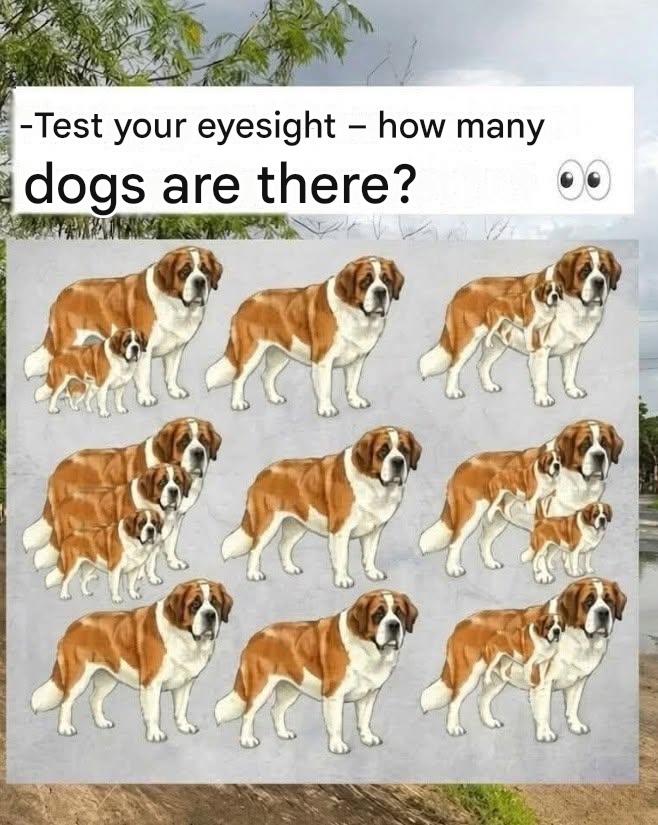
Sixteen different dogs are hidden in this remarkable photo. Some catch your eye almost immediately, while others are so cleverly camouflaged that you have to look at them several times before you spot them. Some of these hidden dogs are even so well hidden that many people start to doubt their own observation skills. This makes this challenge not only fun, but also surprisingly educational.
Take your time to look at the picture. Don’t rush. Look carefully at every detail, every line, and every shadow. If you have the ability to zoom in, feel free to do so. Often, hidden figures only become visible when you look at the picture from a different perspective or when you notice parts you initially ignored.
Visual puzzles have fascinated people for centuries. Long before smartphones, computers, and social media existed, people enjoyed hidden picture puzzles, optical illusions, and hidden images. Magazines, newspapers, and puzzle books were filled with them for years, and children and adults alike spent hours searching for hidden details.
The human mind is naturally curious. We enjoy solving mysteries, recognizing patterns, and discovering hidden meanings. When we solve a puzzle, our brain experiences a sense of satisfaction. This explains why such simple challenges can bring so much joy.
Throughout history, artists have often used hidden images. Some paintings contain multiple faces, animals, or symbols that only become visible when the viewer looks closely. This technique plays on the brain’s natural tendency to seek meaning in what we see. Why people love to search for hidden images
Finding hidden figures activates different parts of the brain. As you search, your brain analyzes shapes, contrasts, colors, and patterns. Your brain is constantly comparing what you see to familiar images stored in your memory.
When you finally discover a hidden dog, you experience a small sense of victory. This so-called “aha moment” gives a sense of satisfaction and encourages you to keep searching. That’s why many people keep searching until they’ve found all the hidden items.
Moreover, such puzzles offer a welcome break from the daily hustle and bustle. They give you the chance to calm down for a moment, focus your attention fully on one task, and clear your mind of other worries.
The Benefits of Visual Brain Teasers
These puzzles are much more than just a pastime. They can support and train various cognitive skills.
Improving observation skills
By regularly searching for hidden objects, you learn to look closely at details. This can also come in handy in everyday life. People who observe well often notice changes, errors, or important details more quickly. Strengthening pattern recognition
Your brain is constantly working to recognize patterns. While solving this puzzle, you are intensively practicing this skill. You learn to make connections between shapes that at first glance seem to have nothing to do with each other.
Increased concentration
Finding sixteen hidden dogs requires focus. You have to ignore distractions and keep your attention fixed on the picture. This helps train your concentration skills.
Develop patience
Not all dogs will be immediately visible. Some shapes require several minutes of careful searching. This helps you practice patience and perseverance.
Mental Stimulation
Just as physical exercise is important for the body, mental activity is important for the brain. Puzzles keep the mind active and engaged.
Increasing self-confidence


